

Guide
How to Make a Vision Board That Actually Works
You know the ritual. New year, new board: the house, the car, the beach, the bank account screenshot. For two weeks it's fuel. By February it's wallpaper — and by March it's a quiet reminder of another strong start that faded.
The board wasn't the problem. The way it was built was. Most vision boards are made to be looked at once. The ones that work are built to be used — daily, in small moments, tied to what you actually do next. Here's how to build that kind.
Why most vision boards stop working
Three design flaws — and none of them are about effort:
They show a finish line, not a direction. A board full of finished outcomes — the house, the title, the number — gives your brain a picture to admire, not a path to walk. Admiration fades. (We broke this down in Vision Boards vs. Visual Goal Setting.)
They're generic. Stock photos of someone else's life: a stranger's kitchen, a model's morning routine. Pretty, and completely forgettable, because nothing in it is yours.
They have no next step. A board that never tells you what to do today becomes decoration. Decoration gets tuned out — that's what brains do with anything that never changes and never asks anything of them.
A vision board you only look at becomes wallpaper. A vision board you use becomes a system.
How to make a vision board that works
1. Start with one intention, not forty pictures. Before a single image, write one sentence: present tense, first person, one focus. "I own my dream home." "I build a business that gives my family freedom." If you don't have the sentence yet, start with How to Set an Intention You Can Actually Act On — the sentence is the board's foundation, and every image on the board has to answer to it. One board, one intention. Three boards for three life areas beat one board with nine competing futures.
2. Choose images your life would recognize. Skip the stock-photo mansion. Choose images that feel like your version: the style of home, the light in the kitchen, the street, the season. Specifics are what make a board stick — your brain flags "that's mine" and skips "that's nice." Add a few words of your own, too: a note in your voice ("I am so grateful to be able to afford this home") lands differently than a quote copied from the internet.
3. Give the board a center. Every board needs one image that holds the whole thing together. In Anchor, that's your personal symbol — generated from your intention sentence itself. (Here's what that means.) A single symbol works differently than a photo: there's nothing to compare or copy, just one mark that means your sentence every time you see it. Research on the Picture Superiority Effect suggests images are remembered through more pathways than words alone — one reason a symbol can stay with you after a list of written goals has faded. More in Symbols & the Subconscious Mind.
4. Attach one next step. Name the smallest move that honors the board this week. Not the whole staircase — one step. "Walk one neighborhood we'd love to live in." "Save the first $100." A board with a move attached gets revisited, because every visit ends in an action instead of a sigh.
5. Put it where your attention already lives. A poster behind a door competes with your life, and loses. Your phone wins your attention a hundred times a day — so a digital board you open in a morning practice will outlast a beautiful board you walk past. What matters is the daily return: sixty seconds, same time, looking on purpose. That return — not the board itself — is where boards earn their keep.
A real board, start to finish
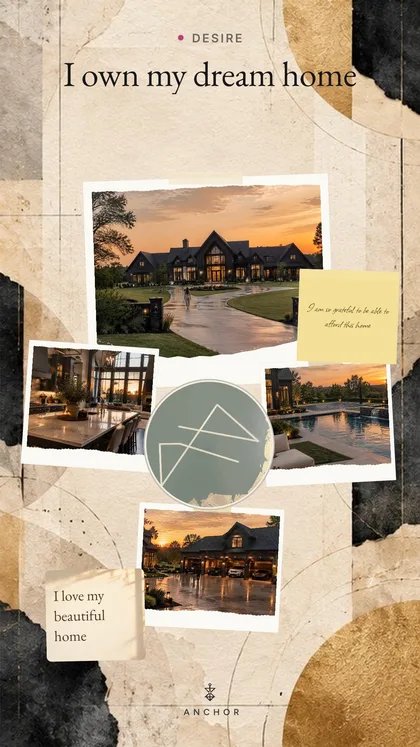
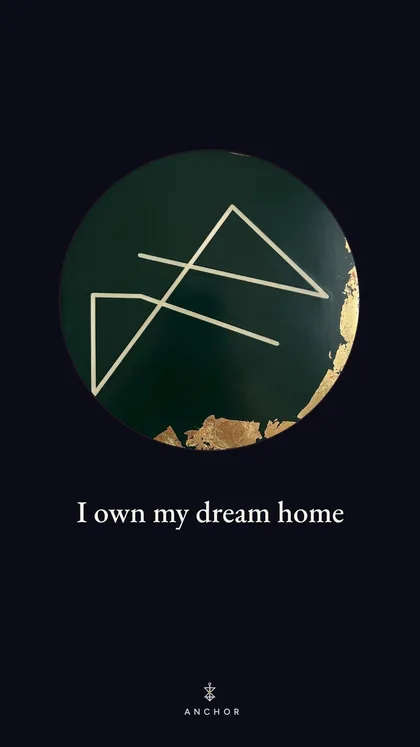
Here's a board made in Anchor from the intention "I own my dream home." The sentence came first. From it, the app generated a personal symbol — the green-and-gold mark — and the board was built around it: the house at dusk, the kitchen light, the pool, the garage, and two notes in the owner's own words. Nothing on it is a stranger's life; every photo answers to the one sentence at the top.
Notice what's not on it: no second goal, no borrowed quotes, no deadline pressure. One intention, one symbol, images you'd recognize as your own future. That's the whole formula.
Mistakes that quietly kill a board
Too many goals at once. Nine futures compete; none of them gets a daily return.
Only outcomes, no identity. Add who you're being, not just what you're getting.
Making it once and never touching it. A board that never changes becomes invisible. Update the photos as the vision sharpens.
Waiting to feel motivated. The return comes first. The feeling follows the reps — not the other way around.
Make yours
Start with the sentence. The free Intention Sentence Worksheet walks you through writing one you can act on — the same worksheet this Journal's readers use before they build anything. When the sentence is ready, your first Anchor in the app is free: build the symbol, render the board, and give it its first next step.
A board that works isn't prettier. It's practiced.
Try it on paper first
The Intention Sentence Worksheet walks you through the method in this article — the five qualities, four worked rebuilds, and a page to build your own sentence. Free, printable, ten minutes.
One list, two jobs: your worksheet now, and first word when Anchor 2.0 launches. No spam, ever.