
Guide
Vision Boards vs. Visual Goal Setting: What’s the Difference?
Somewhere there's a corkboard from last January still hanging in a closet. Magazine cutouts, a sports car, the word ABUNDANCE in gold letters. It was supposed to change everything. Right now it's holding up a grocery list.
This isn't a hit piece on vision boards. If you've ever made one, you felt what they're for — that surge when the future suddenly has a face. The question isn't whether vision boards work. It's what they're missing. Because the board was never the problem. The problem is what happens the morning after you hang it up.
What vision boards get right
Credit where it's due — the classic board does three real things:
It makes the future tangible. A picture of the life you want does something a bullet journal can't: it makes you feel it. That feeling is fuel, and fuel matters.
It's radically accessible. Scissors, old magazines, an hour on a Sunday. No app, no account, no learning curve. Anything that gets a person to sit down and picture their future for an hour is doing something right.
It's a declaration. Putting the board where you'll see it — bedroom wall, closet door — is a genuine act of commitment. You're telling yourself, in public to yourself, that this matters.
None of that is wrong. It's just incomplete.
Where vision boards fall short
To be fair, not every board looks like the one in the closet. Some people build deeply personal boards — their own photos, their own words — and pair them with a real plan. Those boards beat most of what's below. But the typical board has three problems:
It's static. The board doesn't change when you do. By March it's wallpaper — you've seen every cutout a hundred times and stopped seeing any of them. Inspiration without renewal has a half-life.
It's often generic. The classic version is stock photos of someone else's life: a stranger's kitchen, a rental sports car, a beach you've never visited. Nothing in it is actually yours — it's a collage of approximations, and some part of you knows it.
It shows the destination but never the road. This is the big one. The typical board knows exactly what the dream looks like. It has no idea what Tuesday looks like — the ordinary morning when motivation is gone and there's work to do. Most boards have no next step. There's nowhere for "today" to go.
That's why the January board ends up in the closet. Not a willpower problem — a system problem. The board was built to inspire you, and inspiration did its job for about six weeks. Nobody built the part that comes after.
What visual goal setting adds
The missing piece isn't a better board. It's everything that happens after you look at it.
Visual goal setting keeps the image — the future you can see and feel — and connects it to a chain: a symbol that holds your intention, a vision that's actually yours, a daily practice that keeps the connection warm, and a route with concrete next steps. The picture stops being a decoration and starts being the front door of a system.
The difference, in one line: a vision board shows you where you're going; visual goal setting walks you there.
The Anchor system: Create, See, Reinforce, Move
Here's what that chain looks like in practice, inside Anchor:
Create. It starts with a single clear sentence — your intention — transformed into a personal visual symbol. Not a stock photo: a mark distilled from your own words, that carries the whole weight of what you're becoming. (We explain the full journey from sentence to symbol in What Is an Anchor? — and how to write a sentence worth building on in How to Set an Intention You Can Actually Act On.)
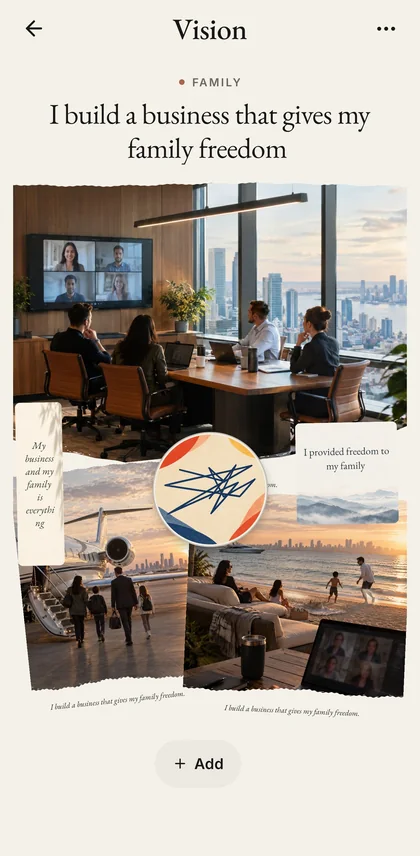
See. Your Anchor holds the intention, but your brain also needs the destination. Anchor's Vision renders your future from your starting point — not a stranger's kitchen, not a rental car. The life you're actually building, made visible.
Reinforce. Motivation fades; practice doesn't. A 10-second Focus session, a longer Deep Focus, or a Visualize session — the daily return that keeps you connected to the vision on the mornings inspiration doesn't show up. The symbol doesn't do the work — you do. Practice just makes sure the work has a trigger.
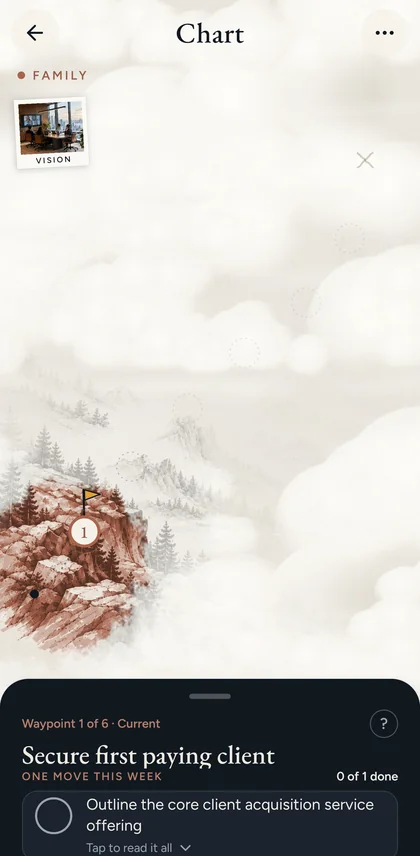
Move. Intentions die in the gap between knowing and doing. Anchor's Chart breaks the distance into waypoints — this week's actual moves, in order — so "become the person" turns into Tuesday's concrete next step.
Symbol, vision, practice, action. Each one is simple. Together they're the part the corkboard never had.
Which one is right for you?
Honest answer: if you love your vision board, keep it. There's no reason to throw away something that makes you feel the future.
But give it what it's missing. Write one clear intention behind it — a sentence in present tense, about who you're becoming. Give that intention a symbol you see every morning, not just in January. And give the dream a next step with a date on it.
Do that, and the board stops being a decoration. It becomes the front door.
Create Your First Anchor — Free
Start with the sentence. Create your first Anchor free — forge your personal symbol and make the intention visible. When you're ready to go further, Vision renders the future you're working toward, Practice keeps the connection warm, and Chart maps the moves — the whole chain, in one place you open every morning.
Try it on paper first
The Intention Sentence Worksheet walks you through the method in this article — the five qualities, four worked rebuilds, and a page to build your own sentence. Free, printable, ten minutes.
One list, two jobs: your worksheet now, and first word when Anchor 2.0 launches. No spam, ever.