Guide
What Is an Anchor?
You know exactly what you want your life to look like. You've written it down, made the board, felt the surge. Then Tuesday happens, and the vision goes quiet.
It's not a motivation problem. It's a connection problem. You don't need another reminder of what you want — you need something that keeps you pointed at it, daily, without effort.
That's what an Anchor is.
The definition
An Anchor is a personal symbol created from your intention — a visual reminder of what you're working toward.
Not a vision board. Not an affirmation list. A single mark, distilled from a single sentence, that carries the whole weight of what you're becoming. Small enough to hold in your mind. Strong enough to pull you back when you drift.
From a sentence to a symbol
Here's what the process actually looks like. Start with one clear sentence, in present tense, about who you're becoming:
"I am disciplined with my mornings."
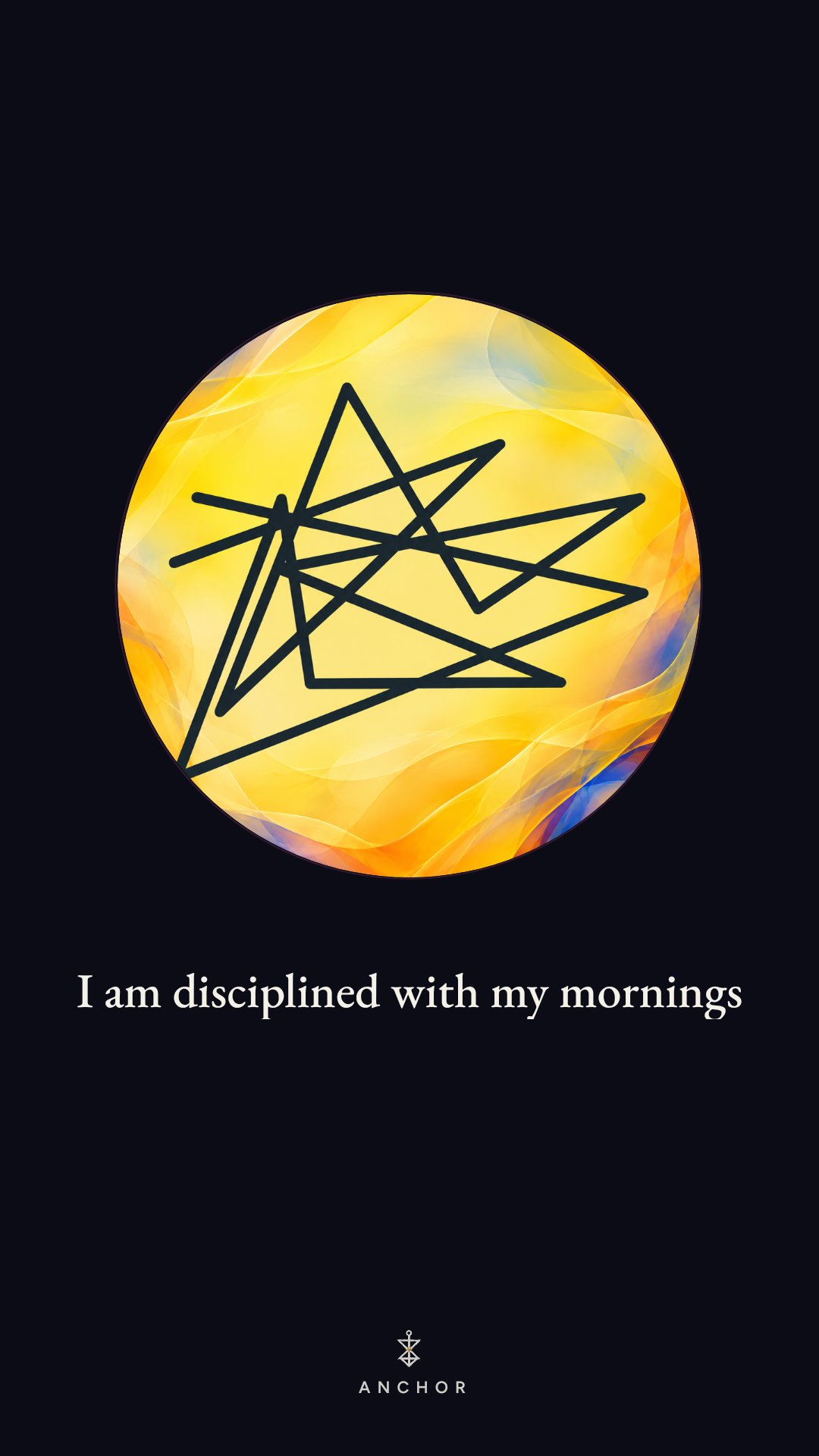
Now reduce it. On paper, you'd write the sentence, cross out the repeated letters, and merge what remains — overlapping the letterforms, simplifying, stripping away everything decorative — until a single mark is left. Nothing legible. Nothing anyone else could decode. Just yours.
The result doesn't need to be beautiful. It needs to be loaded — every line in it traces back to the sentence you wrote. When you look at it, you don't see letters. You see the mornings you're building.
That's the whole transformation: a paragraph you have to re-read becomes a mark you can feel in a glance. The sentence tells you what you want. The symbol reminds you before you have time to negotiate with yourself.
Where this comes from
This isn't a new idea. In the early 1900s, the English artist Austin Osman Spare developed a technique for encoding a statement of desire into a single glyph: write it down, reduce it to its letters, combine those letters into one mark. The practice — later called sigil-making — was picked up by chaos magic practitioners and is still used today.
Anchor is a modern adaptation of that root method, not a replica of the ritual. Traditional practice typically charges the symbol and then deliberately forgets it, on the theory that conscious grasping interferes with the work. Anchor keeps the core transformation — a written intention distilled into an abstract mark — and adapts what happens next: instead of release, daily reinforcement. You don't bury the symbol — you return to it every morning and let it pull one action out of you.
Same core recognition, different practice: a symbol can carry an intention further than a sentence can.
Why a symbol can help you stay connected to an intention
Three ordinary reasons — no mysticism required.
It's easier to notice. A paragraph demands reading; a distinct mark just catches your eye. On a busy morning, the thing you'll actually look at wins. The Anchor earns its glance because there's nothing to parse — you see it and you're back.
Meaning builds through pairing. Think of a song that drops you straight back into a specific summer. The song was neutral once; repetition paired it with the feeling until the link became automatic. Your Anchor works the same way. Each morning you pair the mark with your intention, the association gets a little stronger, until seeing it is remembering.
It anchors a daily practice. Psychologists who study follow-through have found that linking a specific cue to a specific action — when I see this, I will do that — reliably beats vague resolve. The Anchor is the cue. "What's one move that honors this today?" is the action. The symbol doesn't do the work — you do. It just makes sure the work has a trigger.
Beyond the symbol: see it, reinforce it, move on it
A symbol alone is a reminder. Anchor treats it as the first step in a longer chain:
See it. Your Anchor holds the intention, but your brain also needs the destination. Anchor's Vision turns your intention into a visual of the future you're working toward — not a generic dream life, but yours, rendered from your starting point.
Reinforce it. Return to your Anchor through a 10-second Focus, a longer Deep Focus, or a Visualize session. Whether you have ten seconds or ten minutes, the goal is the same: reconnect with what you're building, especially on the days inspiration doesn't show up. (We dig into the mechanics in Morning Affirmations That Rewire Your Day — coming soon.)
Move on it. Intentions die in the gap between knowing and doing. Anchor's Chart breaks the distance into a route with concrete waypoints, so "become disciplined" becomes this week's actual moves.
Symbol, vision, practice, action — each one is simple; together they're a system for becoming. The Anchor is where it starts, not where it ends.
Make yours tonight
Grab a pen. Write the sentence. Cross out letters, merge shapes, simplify until one mark remains. Don't judge it — if it pulls something in your chest when you look at it, it's right.
Then put it where you'll see it tomorrow morning. Phone wallpaper. Bathroom mirror. The first thing your eyes land on.
One sentence. One symbol. One daily return. That's the whole practice — and it works with nothing but a pen.
Create Your First Anchor — Free
Doing it by hand is a fine start. Anchor the app just removes the friction: it walks you through writing the intention, forges your personal symbol for you, renders your Vision, and keeps the whole chain — symbol, vision, practice, moves — in one place you open every morning.
If the idea on this page resonates, the next step is small: make one Anchor, for one intention, and see what a week of returning to it does.
Try it on paper first
The Intention Sentence Worksheet walks you through the method in this article — the five qualities, four worked rebuilds, and a page to build your own sentence. Free, printable, ten minutes.
One list, two jobs: your worksheet now, and first word when Anchor 2.0 launches. No spam, ever.